Ever wonder what people mean when they say you’ve got a round, oval, heart, or even triangular-shaped face? Well, we’re here to decode all that geometry-based mumbo jumbo with some simple “tests” (no calculator required).
The main types of face shape are: oblong, oval, round, rectangular, square, triangular, diamond, and heart.
Have you read Sam’s first post on makeup math, aka the gorgeousness of geometry?
To begin with, mentally measure these areas horizontally (put away your ruler; we only need an estimate to compare them to the other features): your forehead, your temples, across the tip of your nose, across your mouth, and across your chin. Do all of this with a neutral face (i.e. without smiling), and looking straight into a mirror.
 Oblong: The length from temple to temple and across your nose are nearly exactly the same, as well as across your chin and your forehead. Your chin rounds out nicely, and is relatively pronounced. You have a rather high hairline that sweeps more backwards than towards your ears, and your forehead may seem to dominate much of your face. Your jaw is more prominent than many other face shapes. Your goal should be to round out your forehead around the edges, and make your jawline more fluid rather than sloping.
 Oval: The traditionally ideal face shape. The widest part of your face should be the line across your nose, but just barely. The distance across your temples and across your mouth are relatively the same. The distance across your chin is just barely shorter than that of your forehead. Your bone structure is often pronounced, especially your cheekbones. Your hairline sweeps towards the tops of your ears. Feel free to experiment with contouring and highlighting; there’s not much to try and “correct” here. Play up your cheekbones, chisel out your jawline, slim your nose… Completely up to you, you lucky thing.
 Round: Now, don’t you just wanna pinch those cheeks? No. Step away. Anywho… Think of an oval face, as described above. Now, shorten it. All the length-comparisons are about the same, but this type of face is much shorter. The forehead is rather more rounded at the edges (complemented by a hairline that curves rather than sweeps), and the chin is less pronounced. Although the distance across the nose is still the widest, it is now by more than simply a tiny bit. From here, your face curves up to your forehead and down to your chin, rather than sloping. Focus on lengthening your face by shading around the ears and the temples.
 Rectangular: Every distance is relatively equal, except across your chin, which is slightly shorter than the rest. Your face is relatively long, with a pronounced forehead and a squared off jaw. Your cheekbones are often stunning. You may be described as looking statuesque. Your hairline cuts straight across your forehead and then straight down towards your ears. Focus on rounding out your forehead by shading near and above the temples.
 Square: You probably look best with a short hairstyle. Your jaw is the most pronounced area of your face, and may be described as severe (this is a good thing). Otherwise, the square face is to the rectangular as the round is to the oval. It is mostly just a “shortened” version. Your forehead is a bit smaller, and your chin is blunt rather than rounded, enhancing that amazing jawline you’ve got. Focus on rounding out your forehead, but leave that jaw alone. No need to mess with what you’ve got going there.
[Continue reading…]
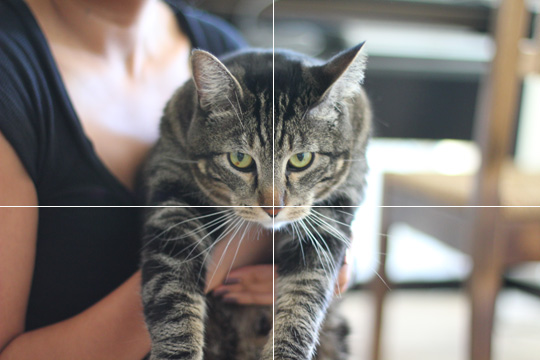
 If you have a rounder face (ain’t you a cutie?), apply a darker contour shade from the horizontal gridline halfway up to the vertical line, and about a third of the way from the lower end of the vertical line to a third of the way to the horizontal, keeping along the border of your face.
  If your face could be described as triangular (a description I hate, but, alas, the makeup world has yet to come up with a better term for it), do the same as you would for a rounder face, except swap in a highlight shade for the area below the horizontal gridline, or forego this step altogether.
 For those with a square or rectangular face (which just means your forehead may be a bit wider and your jaw is a bit more pronounced than someone with an oval face), buff a contour shade midway between the endpoints of the two lines (or the four corners of your face), rounding the edges.
 And if you have an oval face…well, lay down those brushes. An oval shape is generally considered the easiest to apply makeup to, which is why the steps above aim to shape the other types more towards this goal.